
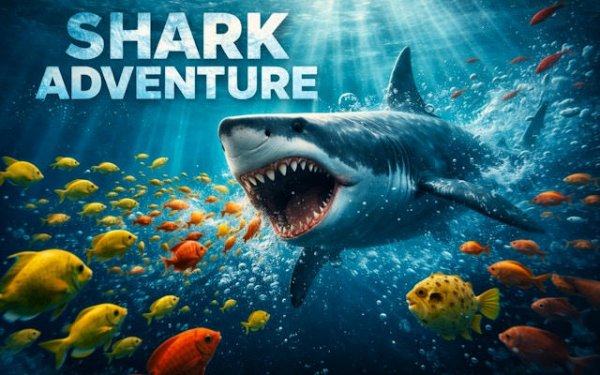
A Predator's Daily Routine
You control a large ocean dweller whose survival depends on two visible metrics: hunger and health. The loop is straightforward—locate prey, feed, and avoid situations that drain health. What makes it engaging is that feeding isn't a simple chase. Smaller fish gather in specific spots, and currents shift with the in-game time of day, so you must observe patterns before committing to a hunt. Patience and positioning matter more than speed.
[IMG_1]Reading the Reef
The reef itself is an active part of the game, not just scenery. Coral formations offer cover and serve as hunting grounds, while open water zones hold different prey and hazards. Some areas become more or less abundant depending on your actions and the in-game cycle. That variability rewards repeated exploration and punishes careless wandering. Learning which zones to check and when to move on is a core skill.
Growth Through Consistent Choices
Progression is tied to how well you manage basic needs. Each successful feeding session contributes to gradual size increases and unlocks new movement or sensory abilities. These upgrades aren't automatic; they require steady performance. The game doesn't hold your hand, so deciding which prey to chase and when to rest becomes a real strategic layer. Sessions build on each other, creating a loop where small decisions accumulate.
[IMG_2]Visual Style and Accessibility
Bright coral contrasts with deep blue water, and fish species are detailed enough to feel authentic. Light rays filter from the surface, and particle effects suggest floating plankton. The art direction stays family-friendly, avoiding graphic depictions while conveying the scale of ocean life. Controls are simple directional commands with smooth response, and the interface shows only health and hunger. No timers or pressure mechanics mean you can play at your own pace, though the underlying systems offer enough depth for older players.

Editorial Notes