
Suspended Tracks and Visual Clarity
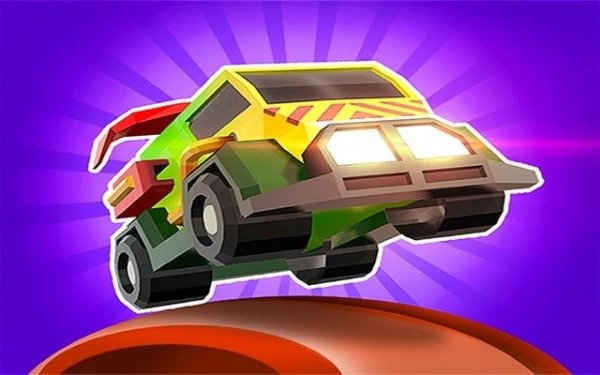
Races take place on pathways suspended in open sky. These routes are not flat: they tilt upward, drop downward, and break apart into gaps that demand well-timed jumps. Because the visual style relies on bright colors and simple 3D models, the track surface and upcoming hazards stay readable even at high speed. The sky backdrop reinforces a sense of forward motion as cars leap between sections. Each run generates a different sequence of obstacles and ramps, so memorizing one layout does not guarantee success on the next attempt.
Vehicle Feel and the Gem Shop
Cars respond quickly to keyboard input. Steering is immediate, and acceleration stays consistent, which makes controlled jumps and clean landings possible with practice. Gems collected during runs serve as currency in the in-game shop. Spending them unlocks different vehicle designs. Handling characteristics remain similar across cars, so the shop mainly changes visual identity rather than performance. That design choice keeps races fair between players using different vehicles while still giving solo players a reason to keep collecting.
Two-Player Races and Solo Distance Goals
The main mode puts two players on the same device, each steering with separate keys. This works well for friends or siblings sharing a keyboard. A single-player mode tracks distance traveled and gems collected, giving solo players a clear number to beat. Both modes use the same track layout and obstacle patterns, so skills transfer directly between them. The scoring system rewards both survival and collection, meaning a cautious run and a risky run can produce different but valid goals.
Reading Ramps and Chaining Jumps
Success depends on looking ahead and adjusting speed before reaching a ramp. The angle of approach determines how far the car flies. A smooth landing preserves momentum; a rough one costs speed. Barriers and gaps require a jump timed to clear them without clipping the edge. Stringing together multiple jumps without slowdowns is the core skill. Each attempt builds familiarity with the track's rhythm, turning repeated runs into a process of learning when to accelerate and when to hold back.






Editorial Notes