
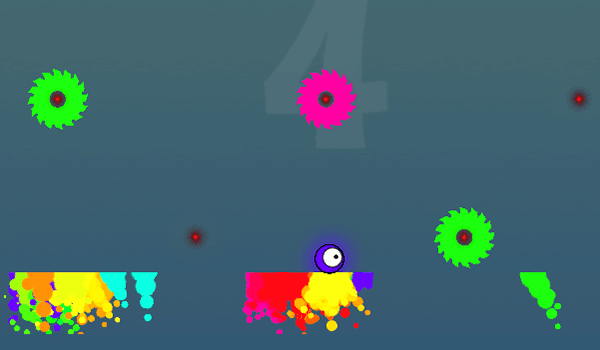
Painting as a Core Mechanic
Hue Trail Platformer builds its platforming around a single twist: many walls and platforms stay invisible until you apply color to them. Your character runs and jumps through each stage, but the path ahead only appears after you paint it. Because the paint supply is limited, every splash is a commitment. You cannot simply coat everything and move on; you must decide which surfaces are worth revealing and when to reveal them.
Reading the Rhythm of a Stage
Each level settles into a rhythm of movement, observation, and resource management. You run, pause to judge what is missing, then paint to expose the next foothold. That loop keeps stages from feeling like straight sprints. Refill items appear along the way, so part of the challenge is deciding when to grab them and when to conserve what you have. Running out of paint leaves new surfaces hidden, which can stop progress until you find another supply.
Visual Style and Level Palettes
The game uses bright, cheerful colors, and each level carries its own palette. Painting surfaces adds a creative layer to the platforming, turning stages into something closer to a canvas. The visual style stays clean and appealing, which suits players of any age. Because color is both a tool and a visual theme, the look of a stage often hints at how it should be approached.
Progression and Difficulty Curve
Stages are arranged in a sequence that gradually introduces new challenges. Early levels teach movement and painting basics, while later stages demand more precise jumps and smarter paint use. Level layouts encourage exploration, since alternative routes may need less paint or hide shortcuts. That design means two players can finish the same stage with different amounts of color spent.
Controls and Accessibility
Controls are straightforward: directional keys for movement, a jump button for leaping, and a separate action button for applying paint. This simple setup makes the game easy to pick up, even for younger players. Responsive controls help deaths feel fair, and retrying a level is quick, which matters in a game where a single misjudged jump can waste paint.





Editorial Notes