What players say
Tronix II offers a satisfying puzzle experience that grows with you. The progressive difficulty keeps it engaging without becoming frustrating. Each level feels like a small achievement. The ad-free, family-safe environment makes it ideal for all ages. It is a great tool for improving spatial reasoning and patience, with high replayability as you revisit earlier puzzles to find more efficient solutions.
About this game
Game Introduction
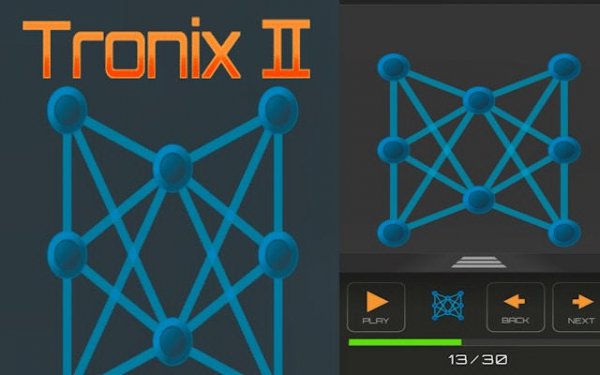
Tronix II: Graph Puzzle Game Online - Logic Puzzle Game is the second installment in a series that transforms abstract graph theory into an accessible and relaxing puzzle experience. Designed for players of all ages, this free, unblocked game presents you with a set of nodes connected by lines. Your goal is to reposition these nodes so that no lines cross each other. There are no loud sounds, flashing effects, or time limits. The gameplay is pure, thoughtful problem-solving that feels both calming and mentally stimulating. It is completely family-safe, making it a great choice for kids and adults to play together.
How to Play
The objective is simple: move the nodes until all connecting edges are free of intersections. Controls are intuitive for any skill level. Click on any node, drag it to a new location, and release it to set its position. As you move a node, all attached lines stretch and adjust, updating the entire graph layout in real time. You do not need any special math knowledge. Only spatial reasoning is required to plan your moves and test different positions until you find a clean, crossing-free configuration. There are no timers or penalties, so you can work at your own pace and enjoy the process.
Game Features
Progressive difficulty introduces more complex graphs as you advance. Intuitive click-and-drag controls make it easy for anyone to start playing. The game is ad-free and family-safe, with no inappropriate content. It offers brain-boosting gameplay that exercises logic and spatial thinking without stress.
Tips for Success
Start by focusing on the most tangled areas of the graph, as clearing those often simplifies the rest. Try moving nodes gradually rather than large jumps to better see how lines adjust. If you get stuck, take a short break and return with fresh eyes—sometimes a new perspective reveals the solution. Practice regularly to improve your spatial reasoning and pattern recognition skills.