
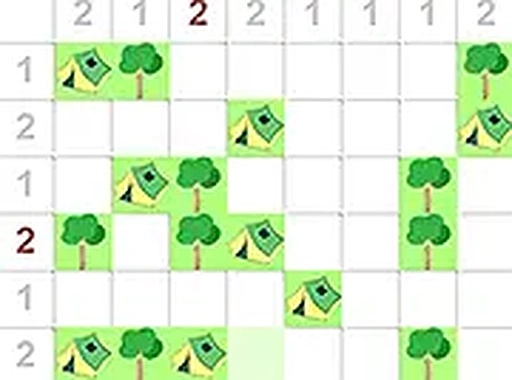
A New Grid Every Day
Timber Grid Daily Challenge refreshes its puzzle board once per day, so the layout of trees and the edge numbers that describe each row and column change regularly. That daily reset gives the game a predictable rhythm: one fresh problem to solve, no repetition of yesterday's arrangement. Because the puzzle is self-contained and resets automatically, there is no backlog to catch up on and no penalty for missing a day.
Marker Placement and Spacing Rules
The objective is to place exactly one marker in a cell directly next to each tree, either horizontally or vertically. Two markers may never touch, not even diagonally, which means every placement constrains the cells around it. The numbers along the grid edges state how many markers belong in the corresponding row or column, and those totals must match when the puzzle is finished. Players can also flag cells as empty to keep track of deductions and narrow down where a marker can legally go.
How the Constraints Shape Each Decision
Because markers cannot share a side or a corner, placing one marker eliminates several neighboring cells at once. That cascading effect is what turns a simple grid into a tactical exercise: a move that looks valid in isolation can block a tree from receiving its required marker later. The edge numbers add a second layer of pressure, since each row and column has a fixed quota that must be satisfied. Working through the grid therefore rewards forward planning rather than quick guessing.
Interface, Feedback, and Pace
The interface uses a clean layout with distinct symbols for trees, markers, and empty cells, and muted colors that suit longer sessions. The game runs in a web browser on both mobile phones and desktop computers, with no download or installation. Controls respond to taps or clicks, and the board updates immediately when a marker is added or removed. There is no timer and no scoring system, so players set their own pace. When every marker is correctly positioned, the game confirms completion.
Who It Suits
Timber Grid Daily Challenge contains no ads, in-app purchases, or distracting elements, and its content is suitable for all ages. The puzzles are demanding enough for adults but simple enough for children to grasp with a little guidance, which makes the game workable for shared screen time or quiet solo play. Its appeal rests on steady reasoning rather than speed or competition.







Editorial Notes