
Aiming and Launching
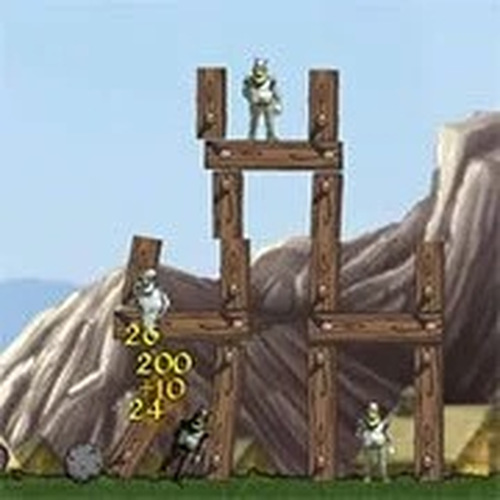
Viking Catapult Challenge puts you behind a catapult with one job: bring down wooden structures. You control two variables—angle and power—before each shot. The mouse or touchscreen interface keeps input simple, but the outcome depends on how well you judge both settings. A shot that lands short wastes a projectile; one that overshoots leaves the structure intact. The feedback loop is immediate: you see exactly where your shot went and why it failed or succeeded. That clarity is what makes each attempt feel like a lesson rather than a guess. [IMG_1]
Projectile Variety and Unlocks
New projectiles become available for purchase as you complete levels. Each type behaves differently in flight, so the same angle and power settings that worked with one projectile may not transfer to another. This forces you to relearn trajectory expectations rather than settle into a single reliable pattern. The unlock system ties directly into level design: later structures tend to demand the specific properties of projectiles you have recently acquired. Choosing the right tool for each layout becomes as important as aiming it well. [IMG_2]
Level Design and Difficulty Curve
Each level presents a new arrangement of wooden structures. Early layouts are straightforward enough to clear with a few well-placed shots, but later configurations require you to identify weak points and plan a sequence of launches rather than fire at the most obvious target. The difficulty increases through structural complexity, not through time pressure or reflex demands. That makes the game approachable for players who prefer thinking through a problem over reacting quickly. [IMG_3]
Who This Game Suits
Viking Catapult Challenge fits players who enjoy casual puzzle-action games that reward patience and spatial reasoning. The Viking theme is presented in a light historical style with no graphic content, keeping the experience suitable for all ages. If you like games where a single well-aimed shot feels more satisfying than a fast sequence of inputs, this one is built around that exact feeling.





Editorial Notes