
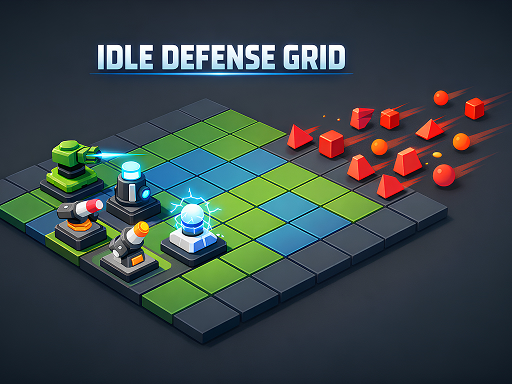
Core Loop and Objective
Strategic Tower Defense Idle asks you to protect a central base from opponents that advance along fixed routes. You place defensive structures on a small grid, and those structures automatically attack anything that comes within range. Defeated opponents yield resources, and a steady trickle of income arrives over time, including while the game is closed. The objective is to hold your ground as waves grow tougher, using earned resources to upgrade existing structures or add new ones.
Placement as a Puzzle
The grid is deliberately compact. Every tile matters, and a poorly placed structure can leave a route uncovered or block a better arrangement later. Because opponents follow set paths, you can study their movement and position defenses to cover the busiest lanes. The constraint turns each placement into a small puzzle: you are not just buying power, you are fitting it into a finite space where structures ideally support one another. This is the game's central strategic tension, and it rewards planning over reaction speed.
Idle Progression and Pacing
Resources accumulate passively, so stepping away does not stall your progress. That design supports short check-ins as well as longer planning sessions. When you return, you can collect what has built up and reinvest it. The pace is relaxed by default: there is no requirement for fast clicking or twitch responses. You can pause, consider your layout, and make changes deliberately. Difficulty rises gradually, nudging you to refine your arrangement rather than overhaul it constantly.
Who This Suits
Players who enjoy tower defense fundamentals, resource management, and low-pressure optimization will find the mix familiar but focused. The clean interface keeps the grid and your resources visible at a glance, which makes it easy to read your own layout. If you prefer action-heavy defense games, the automatic combat and idle income may feel slow. If you like planning, adjusting, and watching a well-built setup hold its ground, the compact board and steady progression are the main draw.








Editorial Notes