
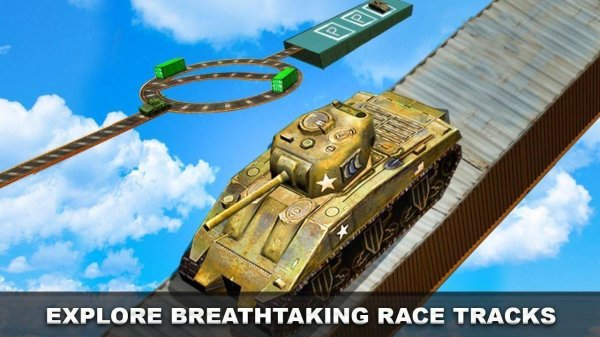
Heavy Vehicle Handling
Precision Parking Challenge builds its puzzle around weight. The vehicles you control are large and heavy, and the physics simulation means they do not stop or turn instantly. Braking distance matters. Turning radius matters. Every input has a delayed, weighty response, so you cannot rush a corner and correct at the last second. This design choice turns ordinary driving into a planning exercise: you read the layout, commit to a line, and adjust gradually rather than making sudden corrections.
Track Layouts and Parking Zones
Each level introduces a fresh configuration. Sharp turns, steep ramps, and narrow parking spaces appear across environments that range from desert bases to urban zones. A path marked on the ground points you toward the parking area, but the real challenge is the final alignment. You must position the vehicle inside a highlighted zone, and the game measures how well you match it. Hitting obstacles can reset your progress, so the safest route is rarely the fastest one.
Stars, Hints, and Progression
Every level has a time limit, and finishing within it earns stars. Those stars unlock new levels, giving the game a clear sense of forward motion. If a layout feels too difficult, hints are available to help you through it. The star system also encourages replay: returning to an earlier level with better control can improve your rating. As you advance, the tracks demand sharper spatial awareness and more precise reversing.
Controls and Camera
On-screen controls handle forward, reverse, and steering left or right. The camera angle is positioned to show your surroundings, which helps when you are backing into a tight spot. Because the controls are responsive but the vehicle is not, the skill lies in anticipating how the machine will move before you press anything. Smooth, gradual inputs work better than abrupt ones, especially in the narrowest zones.






Editorial Notes