
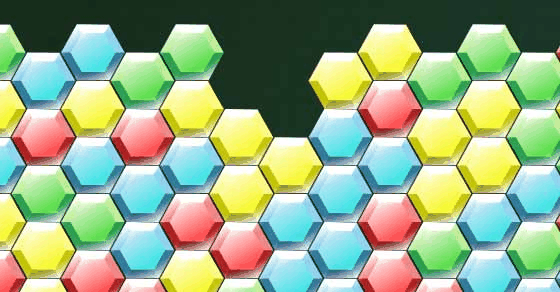
Hexagonal Matching, Not Square Swapping
Most match-3 games use a square grid where you swap adjacent tiles. Hex Break Puzzle changes that foundation. Bricks sit in a honeycomb layout, and you clear them by tapping any brick that belongs to a connected group of two or more same-colored neighbors. That lower threshold—two instead of three—makes early moves feel generous, but the hex grid creates six possible neighbor directions per brick. More connections mean more chances to spot a cluster, and more chances to misread the board.
Stars as a Resource, Not a Timer
You start with three stars. Tapping a brick with no matching neighbor removes one star immediately. There is no countdown clock, so the pressure comes entirely from protecting those stars. This design choice shifts the challenge from speed to observation. You can stare at the grid as long as you want before each tap, which makes the game approachable for players who dislike timed puzzles. The game ends when all three stars are gone, turning every tap into a small risk assessment.
Falling Bricks and Shifting Boards
When you clear a group, bricks above the gap fall downward, and new bricks may enter from the top. That cascade changes the board after every successful tap, so clusters you spotted a moment ago may not survive the shift. Planning two moves ahead helps, but the falling mechanic keeps the grid unpredictable. Chasing a high score means balancing safe clears with the temptation to tap a risky cluster that might expose a larger one.
Who This Suits
The game targets players who want a casual puzzle with a strategic edge. No time limit makes it comfortable for short breaks or longer sessions. The star system adds consequence without punishment—one mistake does not end a run, but three do. If you enjoy match-3 games but find square grids too familiar, the hex layout offers a genuine mechanical variation. If you prefer fast, reflex-driven puzzles, the deliberate pace may feel slow.




Editorial Notes