
How the Grid Works
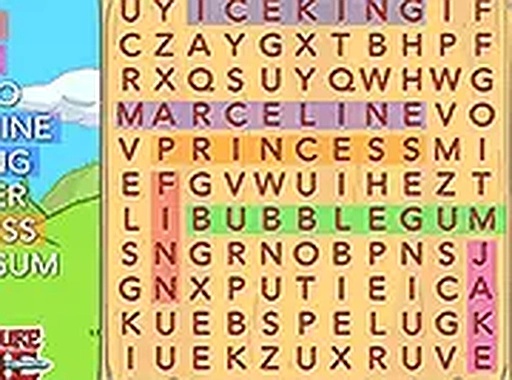
Fantasy Word Search Adventure places a grid of letters at the center of the screen. Hidden inside are words tied to an imaginary fantasy setting, including character names and location titles. The words run in three directions: horizontally, vertically, and diagonally. When you locate a word, the game marks it on the grid, so you can see exactly what you have found and what remains. The target word count is kept modest, which keeps each session from dragging. That balance matters for a word search: too few words feels trivial, too many turns scanning into a chore. Here, the puzzle stays approachable without losing its sense of completion.
Reading the Screen
The interface uses a clean, colorful layout with readable lettering. Because the word list draws from a fantasy vocabulary, the theme comes through in the puzzle content rather than through busy decoration. The design avoids clutter, which helps when you are scanning rows and columns for letter combinations. A cheerful, relaxed tone runs through the presentation, and the visual feedback after each find keeps progress obvious. For a game built around close reading, that restraint is a practical choice, not just a stylistic one.
Playing in a Browser
Everything runs inside a web browser. There is nothing to download or install, and the game works on both computers and mobile devices. Mouse and touch input are both supported, so the same puzzle plays consistently whether you are on a desktop or a phone. Load times are quick, and performance holds up on older hardware. That combination makes it easy to start a puzzle during a short break or hand a device to someone else without setup.
A Fit for Family Play
The content is appropriate for all ages, with no mature themes and no complex mechanics to learn. There is no registration step and no data collection. The game is free to play and does not interrupt play with disruptive ads. Those choices make it a reasonable option for family time or for younger players working through puzzles on their own. The straightforward design also means no prior instruction is needed; the grid and word list explain the task on their own.




Editorial Notes